
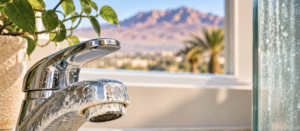




If you’ve lived in Las Vegas for a while, you’ve probably noticed those stubborn white spots on your faucets, cloudy glass shower doors, or mineral buildup around your showerhead.
That’s likely because of hard water, and it’s something most Southern Nevada homeowners deal with regularly.
While those white deposits might seem like nothing more than a cleaning nuisance, the same minerals can also accumulate inside plumbing fixtures and certain household appliances.
So, how much of a concern is hard water, and what can you do about it?
Why Is Las Vegas Water So Hard?
Hard water contains naturally occurring dissolved minerals, primarily calcium and magnesium.
According to the Las Vegas Valley Water District, local water hardness is approximately 16–17 grains per gallon, which falls into the “very hard” category.
Much of Southern Nevada’s drinking water comes from the Colorado River, which carries dissolved minerals picked up along its journey.
The important thing to understand is that hard water isn’t the same as unsafe water. Calcium and magnesium are naturally occurring minerals, and water hardness itself isn’t considered a health concern.
The bigger issue for homeowners is what those minerals can leave behind.
What Does Hard Water Actually Do to Your Home?
1. Mineral buildup on faucets and showerheads
Those chalky white deposits around your fixtures are commonly called limescale.
As water evaporates, dissolved minerals can remain on surfaces. Over time, deposits can accumulate around faucet openings and showerhead nozzles, sometimes restricting water flow.
2. Scale buildup inside water heaters
When hard water is heated, calcium carbonate deposits can form inside water heating equipment.
Over time, this buildup can interfere with heat transfer, reduce efficiency in certain types of water heaters, and contribute to equipment wear.
However, mineral buildup doesn’t automatically mean your water heater is failing. Its condition depends on several factors, including age, design, usage, and maintenance.
3. Reduced water flow through fixtures and plumbing
Mineral deposits can gradually restrict openings in faucets, showerheads, and some plumbing components.
If you’ve noticed a decrease in water pressure at a particular fixture, mineral buildup may be one possible explanation.
Keep in mind that low water pressure can have several other causes, including leaks, valve problems, and supply issues. It shouldn’t automatically be blamed on hard water.
4. Spots on dishes and stubborn soap residue
Hard water can make it more difficult for soap to lather and rinse away cleanly.
It’s also a common reason glassware comes out of the dishwasher looking cloudy or spotted.
While frustrating, these effects are generally cosmetic rather than signs of plumbing damage.
Does Every Las Vegas Home Need a Water Softener?
Not necessarily.
Water softeners are designed to reduce hardness minerals, typically through a process called ion exchange.
They can help reduce mineral deposits, but they’re not required in every home, and installing one is a personal decision based on household needs and preferences.
If you’re considering a system, look into its maintenance requirements, water consumption, and compatibility with your home’s plumbing.
It’s also worth knowing that water softeners and water filters serve different purposes. A traditional water softener isn’t designed to remove bacteria or viruses.
What Can You Do About Hard Water Buildup?
Fortunately, there are a few practical ways to manage the effects of hard water without making major changes to your home.
- Wipe down wet surfaces. Drying faucets, countertops, and shower glass helps prevent mineral residue from forming as water evaporates.
- Clean mineral deposits regularly. Use cleaning products appropriate for the affected fixture or surface, following manufacturer instructions.
- Maintain your water heater. Follow the manufacturer’s maintenance recommendations, and consult a qualified plumber about servicing or flushing when appropriate for your equipment.
- Pay attention to changes in water flow. A clogged showerhead may be a simple maintenance issue, but persistent or widespread pressure changes deserve further investigation.
- Maintain water treatment equipment. If you already have a water softener or filtration system, follow its recommended service schedule.
Can a Home Inspection Identify Hard Water Damage?
A home inspection can identify certain visible conditions that may be associated with mineral buildup, such as deposits on accessible fixtures, visible deterioration, or concerns with plumbing and water heating equipment.
However, a standard home inspection is visual, non-invasive, and doesn’t include environmental testing. It doesn’t determine the full extent of mineral accumulation inside concealed plumbing or water heaters, and it isn’t a substitute for water quality testing or specialized plumbing evaluations.
If you’re experiencing ongoing plumbing problems, a licensed plumber can help determine the cause and recommend appropriate next steps.
A Little Knowledge Goes a Long Way
Hard water is a normal part of living in Southern Nevada, and fortunately, many of its everyday effects can be managed with routine cleaning and maintenance.
The important thing is knowing the difference between common mineral deposits and plumbing concerns that deserve professional attention.
At Spectrum Inspection Group Inc., we’ve proudly served Las Vegas and Southern Nevada since 1998, helping homeowners better understand and care for their properties. As a locally owned, family-operated business, we’re always happy to share our knowledge, answer questions, and be a trusted resource for our community.